Optimizing AI cost: give each thread what it needs, and nothing more
Every AI plan has limits. Breaking work into pieces, each with a complete brief, stretches them further and gets you better answers.

On a Friday afternoon earlier this month, I ran out of usage on my Claude Pro plan. The reset was due the next night and I was in the middle of some nice work with Claude Opus 5.5, so I bought US$100 of usage credit to tide me over. I expected it to last the month, even if I worked twice as hard as usual.
Two hours later, I was horrified to see that two-thirds of it was gone. I hadn’t realised that usage credit is charged at the rates developers pay for the API, so the same work drains it far faster than it drains the usage a plan includes. The next day I moved up to Claude’s Max 5x plan.
It left me wondering how long the generous usage in today’s plans, priced well below those API rates, will last. Are we being given a taste of what this technology can do, and growing to depend on it, until the day we must pay whatever it really costs?
Either way, the answer is the same: learn to use it well now, and get the most out of every bit of usage. Then, if prices do rise, what we get from it will still be worth paying for.
More context, worse answers
That afternoon wasn’t a case of carelessness. I already worked hard at keeping down what Claude reads. Still, it showed me how quickly usage adds up when every new message carries everything that came before it.
The part that surprised me most is this: giving an AI more context than it needs doesn’t only burn your limits. It gives you, quite literally, a worse outcome. Old decisions, abandoned ideas and half-finished side quests all stay in the conversation, and the model has to weigh each of them against your newest request.
The classic mistake is to keep writing in one long thread after the job has clearly changed. It feels efficient, because everything is already there. It’s the opposite. Every AI plan has limits, whether you use Claude, ChatGPT or Gemini, so this applies to all of us.
Break it down, hand it off in pieces
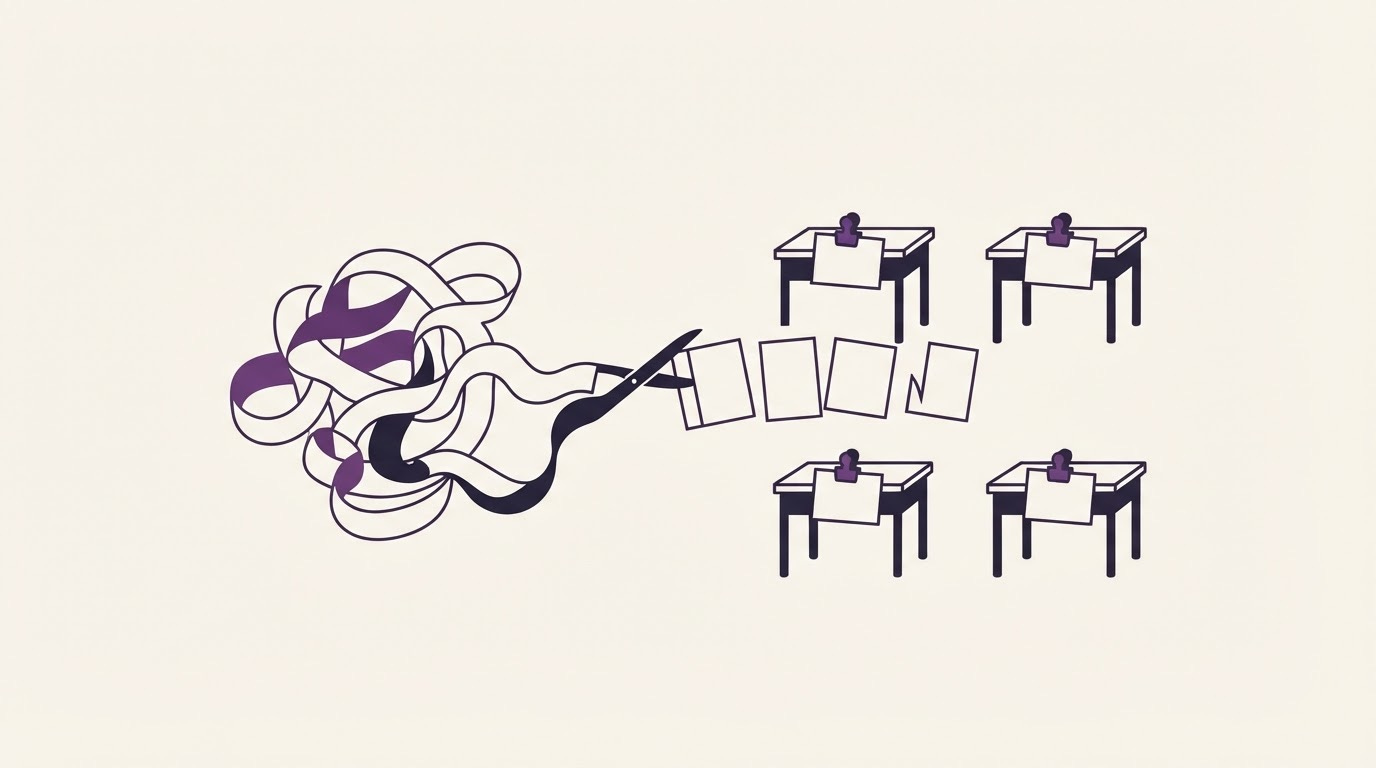
What I like to do is to break a task down first, and hand it off in pieces, so that each thread has everything it needs to do its work, but no more.
Every piece of work starts as an issue in Linear, our project management tool. The issue is the brief: the goal, the facts that matter, where to look, and what not to read. A new thread reads the issue, not the history behind it. When a thread drifts into a different job, I ask Claude to write that job up as a new issue, with only the context it needs, and a fresh session picks it up from there. And when one thread, such as a security audit, turns up several things worth fixing, Claude creates a separate issue for each, holding everything that fix needs, so each one gets its own fresh session.
A few examples from the past month:
The planning thread that grew too big. The thread where Claude and I planned this blog ran for three days and grew so large that I closed it. Now each article gets its own thread, which reads only its issue, a style guide and a list of facts I’ve approved. This article started that way: its issue held my story, the examples, the numbers I’d cleared and what must stay private.
Briefs written before a thread closes. When a thread finishes building something worth writing about, it writes the article brief into Linear before it closes, ending with a line like “Do not read the whole build thread; this issue summarises it.” The writing thread starts lean.
The right model for each piece. When we gave every one of our 1,254 designs a short story, a strong model (Claude Opus 5.5) wrote and refined the brief, and a lighter one (Claude Sonnet 5.5) wrote the stories, one small request at a time. Neither needed the other’s whole conversation.
The nightly job that read 10 million tokens
Our scheduled routines taught me this lesson the hard way. When I first set them up in October, each one fired into an existing project thread. It seemed sensible, since the routine could see what it had done before. But every run carried the whole conversation with it, and the conversation grew every night.
The nightly summary, which writes up everything that changed in the store that day, read between 5 and 11 million tokens a night, often just to report that not much had changed. The bug-fixing routine’s thread grew to about 262,000 tokens of context, and each quiet run got heavier as its history grew.
In mid-October we changed both. Each run now starts as a fresh session, with self-contained instructions that live in our code repository. Every routine’s instructions carry the same line: “Keep the whole check self-contained, this is a fresh session with no memory of prior runs.” When a routine needs to remember something, it reads a file, not an old chat. And a check that doesn’t need our code at all runs as a small standalone task in Claude Cowork, with none of the repository loaded.
The nightly summary now uses about a million tokens a night. A quiet bug-fix run, when there is nothing to fix, takes 47 seconds.
What keeps it lean
A lean setup drifts back to a heavy one unless something holds it in place. Three habits do that for us:
No issue, no thread. Every job is a Linear issue with a clear finish line before any thread starts on it. If I can’t write the finish line, the job isn’t ready.
Routine instructions change only by review. They live in the code repository, and Claude proposes every change as a pull request that I read before it is merged. Each routine reads the latest version when it starts, so nothing creeps in unseen.
The handbook is reviewed too. Every session reads a short set of files about how the store works before it does anything. Those change through pull requests as well, because whatever goes in there, every future session pays for. Our shared project memory keeps only what the code can’t: how I like to work, and what is still in flight.
That handbook is a story of its own. In October we cut what every session reads by about half, and we’ve trimmed it again since. That’s my next article.
What it changed
The routines now run every day on a small fraction of what they used to read. Threads are shorter, and they finish. When I come back to a piece of work a week later, the issue tells both me and Claude exactly where it stands, without anyone rereading a long conversation.
The biggest change is in the answers. A thread that holds one job and the facts for it stays on that job. It doesn’t drag in a decision from three topics ago or a constraint we dropped yesterday. Since the start of October we’ve merged more than 250 changes to the store this way, piece by piece, each one reviewed.
One thing to copy
Before you type the next message in a long thread, ask yourself: is this still the same job? If it isn’t, have your AI write the new job up (the goal, the facts it needs, where to look, what not to read) and start a fresh thread from that. In a Claude or ChatGPT project, that’s a new chat in the same project. In Claude Code, Codex or Cursor, it’s a new session.
Here are two prompts to start with. The first goes at the end of any long conversation, in any AI tool. You get back a short handoff note to paste into a new chat.
This conversation has grown long, and I want to continue in a fresh chat. Write a handoff note I can paste into a new conversation. Keep it under 200 words and include only what the next piece of work needs:

- The goal of the next piece of work, and how we'll know it's done (if we never agreed that, propose it and mark it as your suggestion)
- Decisions we've made that still apply, one line each
- Open questions
- Files, links or documents the next chat should read, and anything it should not read

Leave out abandoned ideas, earlier drafts and side topics. If you're not sure what the next piece of work is, ask me first instead of guessing. Leave out passwords, keys and personal details.
The second shows you what your AI reads every time it starts. Paste it into a chat inside your Claude or ChatGPT project, or into Claude Code, Codex or Cursor in your code folder. For a Gemini Gem, paste it into a regular Gemini chat together with a copy of the Gem’s instructions. You get back a list of what loads, how big each part is, and a proposal for a leaner setup. Change the number in square brackets if you like.
Before we start any work, help me see what you read at the start of every new conversation here.

1. List everything that loads each time: project or custom instructions, attached files, saved memories, and rules files such as CLAUDE.md, AGENTS.md or Cursor rules. Give each a rough size in words, and tell me if something may load that you can't see.
2. For each item, tell me whether most of my tasks need it, some do, or almost none. Point out anything repeated, outdated or contradictory.
3. Propose a lean core that every conversation reads, under [500] words, plus a list of topic files to open only when a task needs them.

If you're unsure what my typical tasks are, ask me a few questions first. Don't change, move or delete anything until I say yes.
Your limits will stretch further. More importantly, your answers will get better.
Michael Kuan runs iStyles.com, which makes Skins for phones, laptops, consoles and drones in over a thousand designs.
Discussion about this post